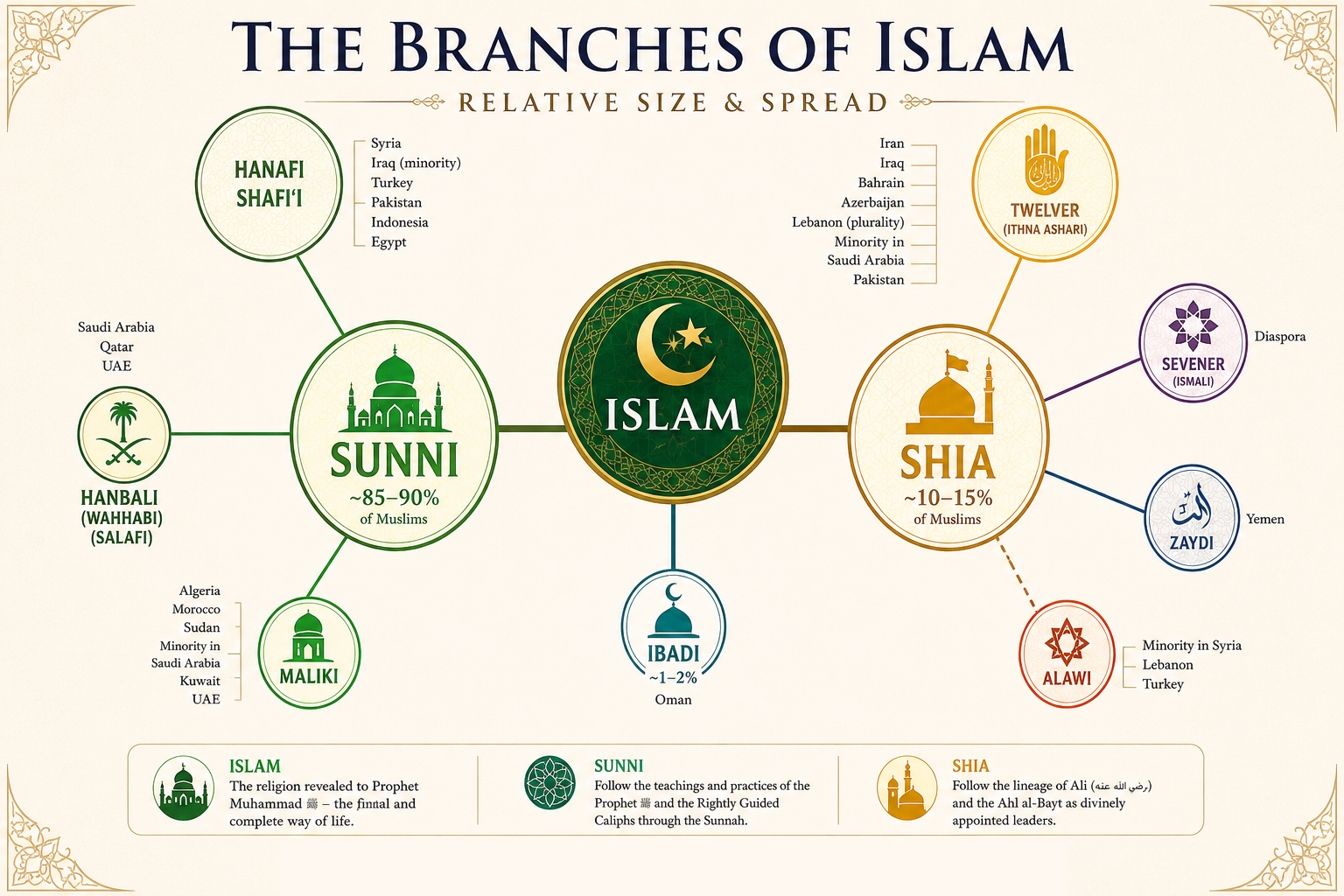
1. Sunni Islam (85% – 90% of global Muslims)
Sunnis follow the Sunnah (traditions of the Prophet) and accept the consensus election of the first four "Rightly Guided" Caliphs. Their internal divisions are split into legal frameworks and theological frameworks.
A. Schools of Jurisprudence (Madhabs)
These are standard systems of law and ritual practice. They recognize each other as completely orthodox.
Hanafi: Founded by Imam Abu Hanifa. Most widespread school. Emphasizes reason and analogical deduction (qiyas). Dominant in South Asia (India, Pakistan, Bangladesh), Turkey, the Balkans, Central Asia, and parts of Egypt.
Maliki: Founded by Imam Malik. Relies heavily on the historical customs of the people of Medina. Dominant across North Africa (Morocco, Algeria, Tunisia) and West Africa.
Shafi'i: Founded by Imam al-Shafi'i. Balances textual traditions with systemic reasoning. Dominant in East Africa (Somalia, Kenya), Yemen, Southeast Asia (Indonesia, Malaysia), and parts of the Levant. [6]
Hanbali: Founded by Imam Ahmad ibn Hanbal. Highly traditionalist; focuses heavily on strict textual readings of the Quran and Hadith. Dominant primarily in Saudi Arabia and Qatar.
Zahiri: A minor, non-mainstream literalist legal school that rejects analogical reasoning. Found historically in Andalusia and currently among select literalist scholars.
B. Schools of Creed & Theology (Aqida)
Ash'ari: Formulated by Imam al-Ash'ari. Uses rationalism (kalam) to defend orthodox scripture. Followed by the vast majority of Shafi'is and Malikis worldwide.
Maturidi: Formulated by Imam al-Maturidi. Extremely close to Ash'arism but gives slightly more weight to human reason. Followed by the majority of Hanafis globally.
Athari (Traditionalist): Rejects dialectical rationalism (kalam). They read descriptions of God literally without asking "how" (bi-la kayf). Embraced by Hanbalis and modern Salafis.
C. Major Modern Cross-Jurisdictional Movements
Salafism / Wahhabism: A strict revivalist movement within the Athari creed. It seeks to return to the practices of the first three generations of Muslims (Salaf) and heavily rejects innovation (bid'ah).
Deobandi: A highly conservative traditionalist reformist movement originating in 19th-century British India, operating within the Hanafi legal framework.
Barelvi: A massive South Asian movement, also Hanafi, formed in reaction to Deobandis. They incorporate traditional folk practices, veneration of saints, and devotional Sufism.
2. Shia Islam (10% – 13% of global Muslims)
Shia Islam originated from the Shi'at Ali ("Party of Ali"). They believe leadership belonged exclusively to the Prophet’s cousin and son-in-law, Ali ibn Abi Talib, and his bloodline (Imams). They split over lines of succession.
A. Twelvers (Ithna Ashariyyah)
The largest Shia branch (roughly 85% of all Shia). They follow a line of 12 divinely appointed Imams. They believe the 12th Imam, Muhammad al-Mahdi, entered a supernatural state of occultation in 878 CE and will return as the Messiah.
Ja'fari Jurisprudence: The official legal school of Twelvers, utilizing rational consensus over rigid analogy.
Usuli: The dominant sub-faction of Twelvers. They follow living high-ranking clerics (Marjas / Ayatollahs) for modern religious decrees.
Akhbari: A minority faction that rejects the authority of modern Ayatollahs, relying strictly on historical rulings left by the 12 Imams.
Shaykhism: An esoteric 19th-century offshoot of Twelver theology focusing heavily on spiritual allegories of the occulted Imam.
B. Ismailis (Seveners)
They split from the mainstream Shia after the 6th Imam. They believed his eldest son, Isma'il, was the rightful 7th Imam rather than the younger son Musa al-Kadhim (whom Twelvers followed).
Nizaris: The largest group of Ismailis. They follow a living, hereditary Imam, currently the Aga Khan. They emphasize a deeply esoteric (batin) interpretation of scripture.
Musta'lis: They split from the Nizaris over a leadership dispute in the medieval Fatimid Caliphate. They believe their Imam is hidden and rule through a representative.
Dawoodi Bohras: The largest group of Musta'lis, heavily concentrated in western India, known for tight-knit community structures and strict organizational systems.
Sulaymani Bohras: A smaller sub-sect of Musta'lis primarily located in Yemen.
C. Zaidis (Fivers)
They split over the 5th Imam, choosing to follow Zayd ibn Ali. They are the closest Shia branch to Sunni Islam, as they do not believe their Imams are infallible or possess divine attributes. They are concentrated almost entirely in Yemen (the Houthi movement belongs to this branch).
D. Syncretic & Esoteric Shia Offshoots (Ghulat)
These groups split historically from Shia lines but integrated distinct esoteric or pre-Islamic beliefs.
Alawites (Nusayris): Located primarily in Syria. They treat Ali with highly exalted, near-divine reverence and practice highly secretive rituals.
Alevis: Concentrated in Turkey. They merge Twelver Shia reverence for Ali with Anatolian folk culture and Sufi mysticism. They worship in assembly houses (Cemevis) instead of traditional mosques.
3. Independent Branches (Non-Sunni, Non-Shia)
A. Kharijites and Ibadism
The Kharijites were the very first schism in Islam, breaking away during the first Islamic civil war because they rejected compromises made by both Ali and the Umayyads. They believed any pious Muslim could be elected leader. While violent Kharijite sub-sects went extinct, one moderate branch remains:
Ibadism: Neither Sunni nor Shia. It is the dominant school of faith in Oman and exists in small pockets of North Africa (Zanzibar, parts of Algeria and Tunisia).
B. The Ahmadiyya Movement
Founded in 1889 in British India by Mirza Ghulam Ahmad, who claimed to be the promised Messiah and Mahdi. Mainstream Sunni and Shia authorities universally consider Ahmadis to be outside the fold of orthodox Islam due to views on final prophethood.
Ahmadiyya Muslim Community (Qadiani): Believe Ahmad was a non-lawbearing prophet following Muhammad.
Lahore Ahmadiyya Movement: A small breakaway faction that views Ahmad strictly as a reformer (Mujaddid) rather than a prophet.
4. Sufism (Tasawwuf)
Sufism is not an independent political or legal sect, but rather an inner, mystical dimension of Islamic practice focused on spiritual purification (ihsan). Sufis exist across both Sunni and Shia landscapes and organize themselves into spiritual paths called Tariqas.
Naqshbandi: Highly orthodox order prevalent in Turkey, Central Asia, and South Asia.
Qadiri: One of the oldest orders, founded in Baghdad, spanning Africa and Asia.
Chishti: Highly popular across India and Pakistan; famous for incorporating devotional music (Qawwali).
Shadhili: Dominant across North Africa and Egypt.
Bektashi: A highly syncretic Sufi order prominent in the Balkans and Albania, historically linked to Ottoman janissaries.
Comprehensive Comparative Matrix
| Branch / Sect | Percentage | Foundational Rule of Succession | Primary Geographic Base |
|---|
| Sunni (Hanafi/Shafi'i/etc.) | ~85–90% | Elected community consensus (Caliphate) | Global (Indonesia, S. Asia, Mideast, N. Africa) |
| Shia (Twelver / Ja'fari) | ~10–12% | Divine lineage of 12 specific Imams | Iran, Iraq, Azerbaijan, Lebanon, Bahrain |
| Shia (Ismaili) | <1% | Divine lineage tracking through Isma'il | Scattered (S. Asia, E. Africa, Syria, Tajikistan) |
| Shia (Zaidi) | <1% | Any qualified descendant of Ali who fights injustice | Yemen |
| Ibadi | <1% | Leadership by the most pious, regardless of lineage | Oman, Zanzibar, pockets of N. Africa |
The Druze: historical connection and present identity
The Druze (Muwahhidun) are classified historically as an extreme esoteric offshoot of Shia Islam, but today they are considered an entirely independent, distinct religion rather than a sect of Islam. Mainstream Islamic scholars (both Sunni and Shia) do not consider the Druze to be Muslims, and the Druze themselves maintain a highly distinct identity.
Here is exactly where they fit into the historical tree and why they are separate today:
1. The Historical Root: The Ismaili Shia Split
The Druze emerged in 11th-century Cairo within the Fatimid Caliphate, which was a major Ismaili Shia empire.
The Catalyst: A group of Ismaili scholars began teaching that the sixth Fatimid Caliph, Al-Hakim bi-Amr Allah, was not just an Imam, but a divine incarnation or the cosmic intellect.
The Break: When Al-Hakim vanished mysteriously in 1021 CE, these followers believed he had entered a state of occultation (hiding) and would return to bring a new age. This caused a permanent break from Ismaili Islam.
2. Why They Are Considered Independent (Not Islamic)
While they originated from a Shia root, the Druze developed an entirely unique theology, closing their doors to new converts and intermarriage in 1043 CE. Their system differs fundamentally from mainstream Islam in several major ways:
The Scriptures: Instead of relying solely on the Quran, their primary holy text is the Hikmat al-Sharifa (Epistles of Wisdom), a secretive collection of texts written by the movement's early founders.
Reincarnation (Taqammus): The Druze believe in the immediate transmigration of souls upon death. When a Druze dies, their soul is instantly reborn into another Druze newborn. Mainstream Islam strictly rejects reincarnation.
Abolition of Rituals: The Druze do not practice the Five Pillars of Islam. They do not fast during Ramadan, perform the Hajj pilgrimage to Mecca, or pray in traditional mosques. They gather instead in private meeting houses called Khalwa.
Neo-Platonic Philosophy: Their theology is heavily infused with Greek philosophy (such as Plato, Aristotle, and Plotinus), Gnosticism, and ancient Egyptian mysteries.
3. Internal Structure: The Wise vs. The Ignorant
The Druze community is strictly divided into two distinct social and religious classes:
The Uqqal (The Wise): A minority of initiated men and women who wear traditional clothing, maintain strict moral codes, and are allowed to read the secret holy books.
The Juhhal (The Ignorant): The majority of the population who are uninitiated. They do not have access to the secret texts but follow the community's general moral laws.
4. Geographic Base
The Druze are a tightly knit ethnoreligious group of roughly one million people. They are heavily concentrated in the mountainous regions of the Levant:
Syria: Primarily in the Jabal al-Druze region.
Lebanon: Focused in the Chouf Mountains.
Israel and Palestine: Primarily located in the Galilee and Mount Carmel regions.